Global equities extended their advance this week, with the S&P 500 up 3.6% and the Nasdaq surging 5.2% on a chip stock rebound, both indices posting their best weekly performance since April. The catalyst was a surprisingly weak July US jobs report: nonfarm payrolls fell by 23,000 against expectations of an 83,000 gain, while unemployment ticked down to 4.1% as participation dropped to a five-year low. Markets read the print as a green light for the Fed to stay on hold, with futures now pricing a clear majority for no move at the September meeting, a sharp reversal from the 55% hike probability priced just a day earlier. The 10-year Treasury yield fell nine basis points to 4.65% on the back of it.
Beneath the headline numbers, US small-cap earnings are quietly having their best season since 2001, with Russell 2000 sales growth running at 9%, up from 7.5% pre-season and broadening out from energy, materials and industrials rather than staying concentrated in mega-cap tech.
In Europe, the STOXX 50 added 2.6% on firmer risk appetite, even as the geopolitical backdrop stayed unsettled. Services PMIs in France and Germany improved meaningfully with France gaining to 49.8 from 46.8, its best reading in seven months, while Germany increased to 49.8 from 48.6, though both remain in contraction territory below 50.
A less-discussed but increasingly relevant theme is water: record-low levels on the Rhine and Danube are pushing up barge freight costs and forcing production cuts at Hungarian auto and battery plants, with knock-on pressure on Romanian power generation.
The UK saw services and broader private-sector headcount contract for a 22nd straight month, matching the length of the 2008–09 downturn, while government reluctance to rule out higher bank taxes in the upcoming budget is adding a layer of uncertainty for financials. The FTSE 100 still managed a 0.3% gain for the week.
In Asia, the yen firmed early in the week on intervention speculation before the persistent US-Japan rate differential reasserted itself. The Bank of Japan remains caught between rising inflation pressure from the oil shock and a weak currency on one side, and soft domestic demand on the other. The Nikkei still added 2.1%.
In China, accelerated fiscal spending and a reaffirmed “moderately loose” policy stance from the PBoC supported the Shanghai Composite’s 2.8% gain, with Beijing’s chip self-sufficiency drive gaining traction. Domestic manufacturers are now expected to supply 46% of Chinese firms’ AI accelerator budgets over the next year, up from 30% currently.
Gold had a standout week, up 7.43% to $4,341.52/oz and briefly topping $4,350 on Friday, a two-month high, as falling energy prices and softening labour data reinforced the lower-for-longer rate narrative. Brent, meanwhile, fell over 8% for the week on hopes of a US-Iran deal to keep the Strait of Hormuz open.
Looking ahead: Strait of Hormuz negotiations remain the key swing factor for energy prices and the broader rate outlook. US CPI data lands this week with the Fed and markets still split on the September decision, and AI-trade volatility bears watching after last week’s chip-driven bounce.
Market Moves of the Week:
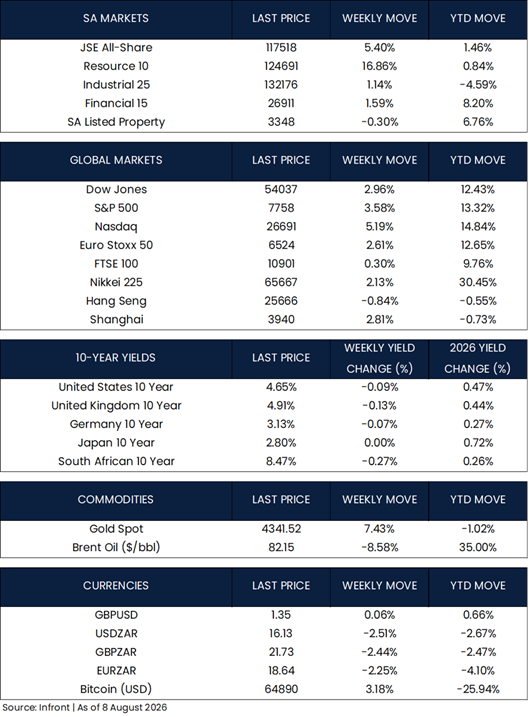
South African assets had a strong week on the back of encouraging policy signals from National Treasury, which noted that domestic bond spreads have tightened to levels now comparable with investment-grade emerging-market peers. Treasury also outlined plans for a principles-based fiscal rule, a structural shift worth watching for its longer-term implications for fiscal credibility and sovereign risk pricing. Separately, government confirmed plans to list its first US$500 million credit-guarantee vehicle, aimed at drawing private capital into infrastructure, with electricity transmission flagged as a priority area.
Domestic data was more mixed. The S&P Global South Africa PMI eased slightly to 50.3 in July from 50.5, holding just above the expansion threshold, while new vehicle sales rose a healthy 11.9% year-on-year, a reasonable proxy for consumer resilience given the interest rate environment.
Markets responded positively across the board. The 10-year government bond yield fell 27 basis points to 8.47%, and the rand strengthened 2.51% to R16.13 against the US dollar. The JSE All Share Index gained a strong 5.40% on the week, led by resources with the Resource 10 Index surging 16.86%. Financials and industrials also advanced, up 1.59% and 1.14% respectively, while listed property was the lone laggard, down 0.30%.
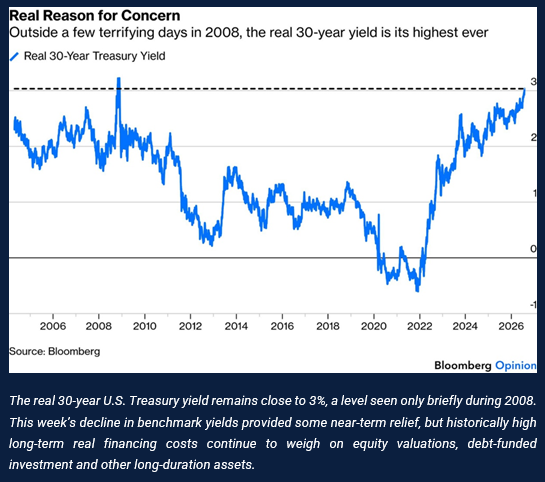
Chart of the Week:
Important Information
The information included above as well as individual companies and/or securities mentioned should not be construed as investment advice, a recommendation to buy or sell or an indication of trading intent on behalf of any STRATEGIQ Capital product. This material is provided for informational purposes only and is not intended to be investment advice or a recommendation to take any particular investment action. Information contained herein is based upon sources we consider to be reliable; we do not, however, guarantee its accuracy. All charts and tables are shown for illustrative purposes only.
STRATEGIQ Capital is an authorised financial services provider (FSP 46624).