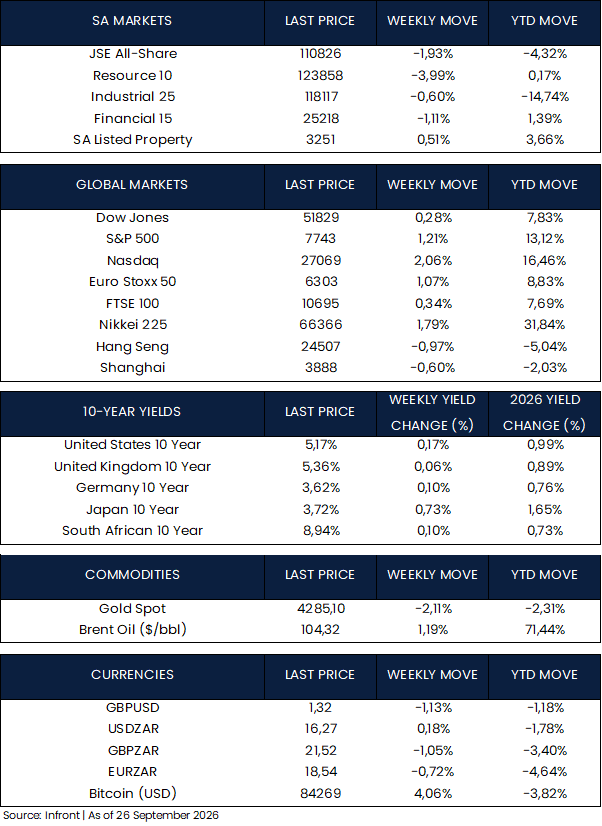
Global equity markets ended a turbulent week on a positive note, with US shares rallying on Friday despite a sharp rise in government bond yields that unsettled investors earlier in the week. The Dow Jones finished the week 0.3% higher, while the broader S&P 500 gained 1.2% and the technology-heavy Nasdaq rose 2%. Sentiment was also helped by a pullback in oil prices, with Brent crude falling 2.1% to $104.32 a barrel on renewed hopes that the Strait of Hormuz, one of the world’s most important shipping routes for oil, could reopen.
That optimism followed a proposal from Iran asking the US to return to the interim agreement reached in mid-June, which had produced a short-lived ceasefire before collapsing a few weeks later. Iran’s foreign minister offered to reopen the strait and resume nuclear talks within seven days, provided the US lifts its naval blockade, releases frozen Iranian assets and agrees to end the conflict on all fronts. Encouragingly, oil flows through Hormuz held steady at around 33.7 million barrels this week. Even so, oil markets remain highly sensitive to headlines, swinging between hopes for peace, signs of recovering Middle East energy supplies and speculation that the US may restrict diesel exports.
The US economy itself continues to show surprising strength. S&P Global’s September survey of business activity showed the economy expanding for a fourth consecutive month, with the composite index climbing to 58.4, its highest level in more than five years (any reading above 50 signals growth). Services led the way, rising to 58.7 from 56.5, while manufacturing also picked up meaningfully, rising to 57.0 from 53.9.
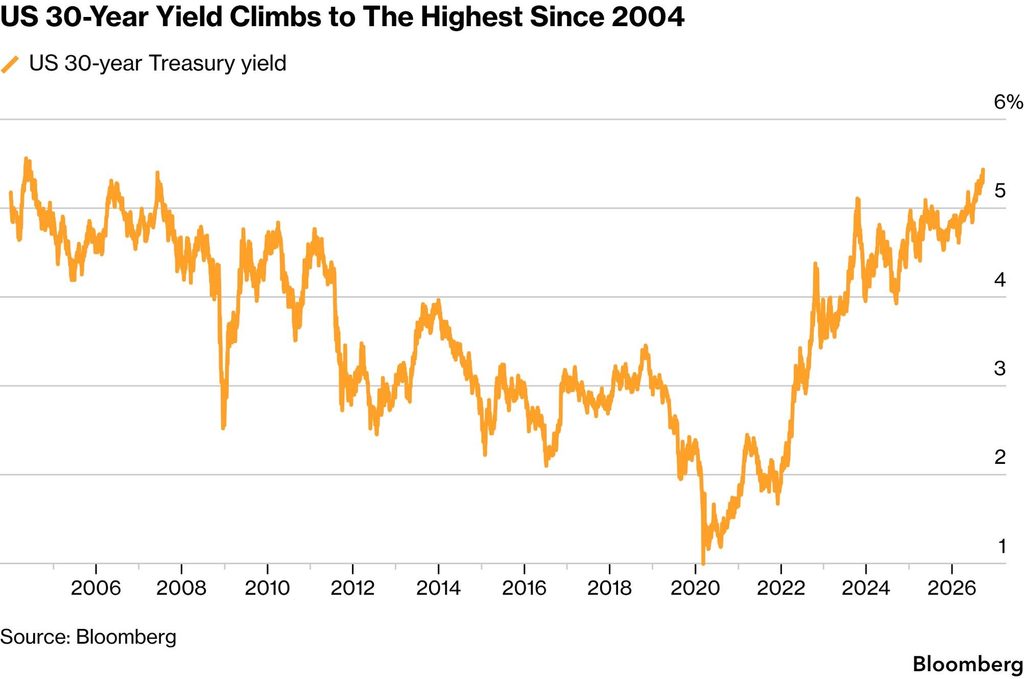
This strength, however, is a double-edged sword. Bond markets reacted sharply, with the yield on the 10-year US Treasury rising to its highest level since 2007 and the 30-year yield reaching levels last seen in 2004, closing the week at around 5.16% and 5.49% respectively. Rising yields reflect growing concern that inflation will stay stubbornly high, fuelled by elevated energy prices, a robust economy and hawkish comments from Federal Reserve Governor Michael Barr. Markets are now pricing in a roughly 64% chance that the Fed will raise interest rates in October, a notable shift from the rate-cutting expectations that dominated earlier in the year. For investors, higher yields matter because they raise borrowing costs across the economy and increase competition for equities from lower-risk assets.
American households are feeling the pressure. The University of Michigan’s consumer sentiment index fell 7% in September to 48.1, though this was marginally better than expected. More concerning was the jump in near-term inflation expectations, with consumers now anticipating inflation of 4.6% over the next year, the highest reading since June.
On the diplomatic front, Chinese President Xi Jinping concluded his first formal visit to Washington in 11 years. While the three-day state visit was rich in ceremony, from a state dinner to a promised pair of pandas for Atlanta, it produced little of substance. There were no major purchase commitments and no progress on artificial intelligence risks or the war in Iran. The one concrete outcome was an agreement to extend the existing US–China trade truce until 10 January, which removes a near-term source of uncertainty for markets.
In Europe, the STOXX Europe 50 rose more than 1% over the week as investors weighed improving economic growth and enthusiasm around artificial intelligence against concerns that high energy prices could prompt the European Central Bank to raise rates further. Eurozone business activity came in well ahead of expectations, with the composite index rising to 53.1 from 52.0. Germany strengthened, and France returned to growth for the first time in ten months. The picture in the UK was more subdued. Retail sales weakened further and orders placed with suppliers fell at the fastest rate since records began in 1983, while overall business activity slowed as the services sector lost momentum. The FTSE 100 nonetheless edged 0.3% higher.
In Asia, Japanese markets traded for only two days due to public holidays, but made up for lost time with the Nikkei 225 rising 1.8% as AI and semiconductor shares caught up with the earlier gains in US technology stocks. Chinese markets were softer, with the Shanghai Composite down 0.6% ahead of Friday’s Mid-Autumn Festival holiday and Hong Kong’s Hang Seng Index falling 1.0%, weighed down by technology stocks.
Looking ahead, developments between the US, Iran and Gulf states will remain firmly in focus, as energy prices and resilient economic data continue to push global bond yields to multi-decade highs. In the US, attention turns to the September jobs report, alongside key inflation data in the form of the PCE price index, as well as personal income and spending figures and the ISM business surveys. In Europe, inflation and unemployment figures will be closely watched, with markets already anticipating several rate hikes from the ECB, while China releases its latest business activity data in a holiday-shortened week.
Market Moves of the Week:
The South African Reserve Bank (SARB) raised interest rates for the second time this year on Wednesday, lifting the repo rate by 25 basis points to 7.25%. The decision was widely anticipated and the Monetary Policy Committee voted unanimously in favour. For households and businesses, this takes the prime lending rate to 10.75%, meaning slightly higher repayments on home loans, vehicle finance and other variable-rate debt.
Governor Lesetja Kganyago explained that the war in Iran has triggered large and sustained price shocks, and that tighter policy is needed to stop higher inflation from becoming entrenched in the economy. While he acknowledged that the global economy had absorbed some of this year’s energy shocks reasonably well, he cautioned that vulnerabilities are building, with renewed fuel-price pressure the most immediate concern for South Africa.
The hike comes at a difficult moment for the local economy, which contracted by 0.2% in the second quarter. The SARB nonetheless expects activity to recover in the second half of the year, forecasting growth of 1.2% for 2026 and around 2% over the medium term, though the Governor noted that the risks to this outlook remain tilted to the downside. The next and final rate decision of the year is scheduled for Thursday, 19 November.
Earlier on Wednesday, Statistics South Africa reported that consumer inflation edged up to 4.4% in August from 4.3% in July. This was slightly better than the 4.5% economists had expected, and core inflation, which strips out volatile food and fuel prices, eased to 4.1% from 4.2%. Prices were also flat month-on-month on both measures. However, food inflation ticked higher for the first time since November 2025, rising to 1.1% from 0.9%. Importantly, headline inflation now sits 1.4 percentage points above the SARB’s new 3% inflation target, which helps explain the Bank’s willingness to act even as growth remains fragile.
Local markets had a softer week. The FTSE/JSE All Share Index fell 1.9%, dragged lower by a 4% decline in resource shares, while the rand weakened to R16,27 against the US dollar. Local bonds also came under pressure, with the yield on the South African 10-year government bond ending the week at 8.94%.
Chart of the Week:
Important Information
The information included above as well as individual companies and/or securities mentioned should not be construed as investment advice, a recommendation to buy or sell or an indication of trading intent on behalf of any STRATEGIQ Capital product. This material is provided for informational purposes only and is not intended to be investment advice or a recommendation to take any particular investment action. Information contained herein is based upon sources we consider to be reliable; we do not, however, guarantee its accuracy. All charts and tables are shown for illustrative purposes only.
STRATEGIQ Capital is an authorised financial services provider (FSP 46624).